AI product management case study · Fictional targets and real-filing backtests · November 2026

Project Falcon

Multi-agent M&A due diligence, built in Claude Code

An AI diligence team that researches an acquisition target across SEC filings, news, court records and financials, connects what no single source shows, and drafts an Investment Committee report, with people approving each stage.

12blind graded runs on 6 fictional targets
96% to 100%Critical and High recall, four held-out targets
0unsupported findings in any report
38 → 13report pages, runs 4 to 6
75% to 78%lower cost per deal than two analysts (page 2)

The problem

Diligence takes teams of associates weeks of reading filings, news, dockets and data-room financials, and the worst issues hide between sources. Autonomous agents could help, but they are the hardest AI pattern to control, so high-stakes work needs human checkpoints.

What I built

  • Agent Core: a lead agent (CLAUDE.md) running a bounded Plan, Act, Observe loop (at most three iterations).
  • Four specialists in parallel: SEC filings, news, litigation and financials. One source each, read-only.
  • Independent citation verifier: re-opens every cited source and recomputes the numbers behind each Critical and High finding.
  • Working memory as plain files: plan, findings register, conflicts, run log and every unedited agent report. Fully auditable.
  • Three human checkpoints: approve the plan, review the red flags, sign off.
  • Testable guardrails: no web access, protected sources, a prompt-injection rule, approval to open the answer key, 69 automated checks.

Key decisions

  • Specialists by source, not topic, so connecting sources is the lead agent's job. The Critical issues only appear there.
  • Separation of duties: analysts cannot change anything; a separate verifier checks them, like a deal-team reviewer.
  • Measured, not assumed: 18 planted issues, 4 distractors and an answer key the analysts and verifiers never see.
  • Planned like a product: specs and a phased plan with tests for each phase, agreed before building.

Real filings: two backtests

Two backtests ran on a real company's SEC filings as of a cutoff date (2018 and 2014), with a hypothetical deal and a key of warning signs the later public record showed mattered. Limits first: one company each, picked by a session that knew the outcome; no distractors, so false alarms are untested; the companies and reports stay private. Found: 10 of 10 signs, then 5 of 8 plus 3 in part (81.3% scored, 62.5% on full finds alone). Both: 0 unsupported findings, 0 hindsight leaks.
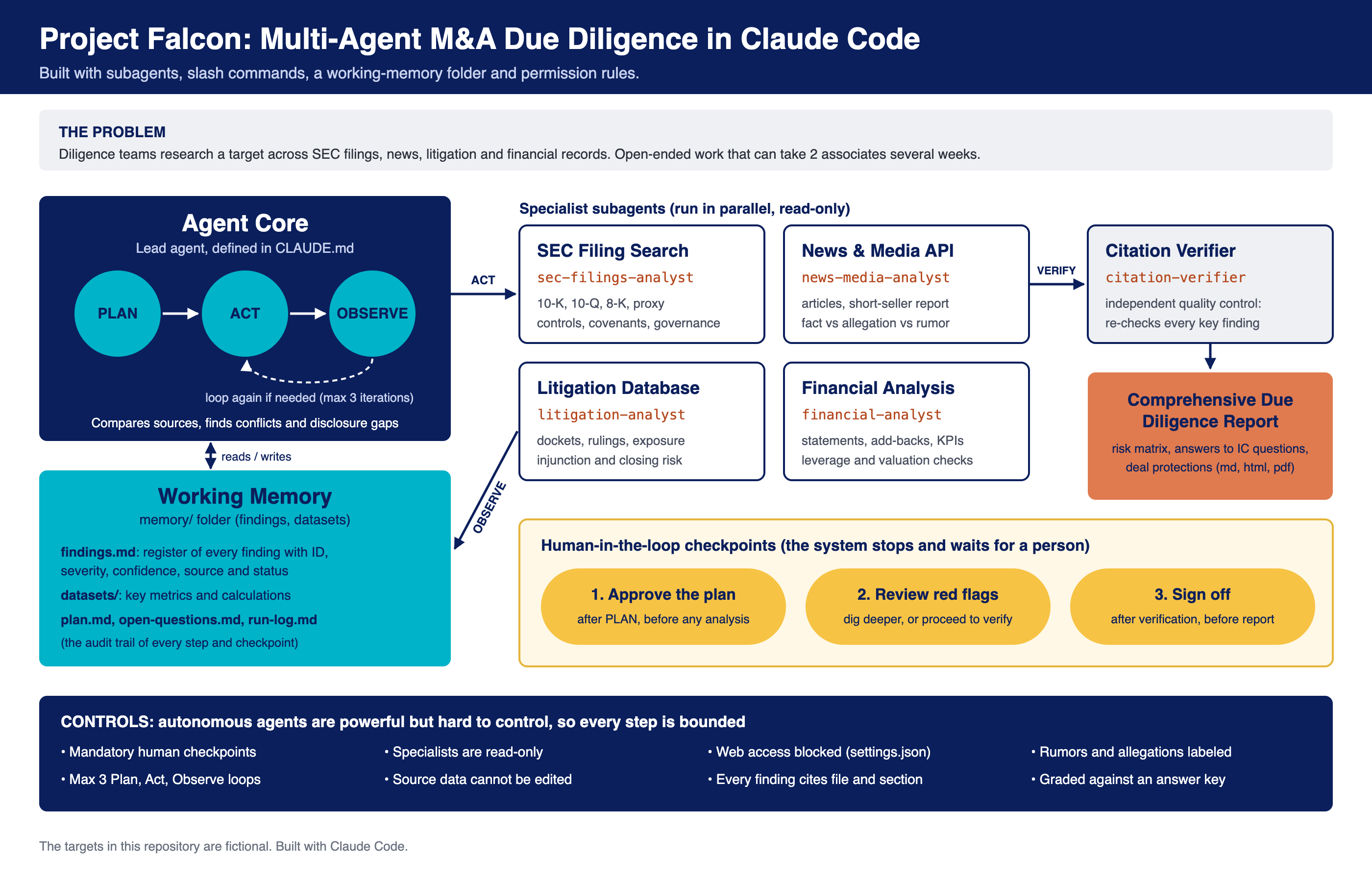
Architecture: the Agent Core loop coordinating four specialist tools, working memory, a citation verifier and three human checkpoints, ending in the due diligence report
Architecture: Agent Core, four specialists, working memory, verifier and human checkpoints.

What the system concluded

All six Falcon runs: do not proceed at $24.00 per share. The committee decides.
  1. The valuation used guidance the target had already replaced: about 18.3x on current guidance, not the 11.5x in the deal model.
  2. A patent case turned against the target in July, with an injunction sought on robots behind about 42% of revenue. The next quarterly filing left the ruling out.
  3. A customer worth 31% of revenue can leave after a change of control, and is building its own robots.

What I learned

  • The verifier earned its place: 17 of 61 findings needed corrected wording before the report (one claimed 18 months of negative free cash flow; it was 12).
  • Three runs, not one: the same misses repeated, so they were design gaps, not luck. I fixed them, and run 4 found all 18.
  • Then quality: Critical must name its test, duplicates fold into one parent, cross-source findings are self-checked. Reports fell from 38 to 13 pages; recall held at 100%.
  • Then generalization: four held-out targets, 96% to 100% of Critical and High issues found, nothing invented. Exact severity is the open gap: 77.8%, 88.9%, 72.2%, 72.2%.
How blind was the test? Each graded run started in a fresh session that never saw the answer key or an earlier run. Heron's, Wren's and Avocet's builders never saw the instructions; Plover's could. A different session graded Wren and Avocet.

Cost and time per deal: this system versus a manual first pass by two analysts

Professional setup, for a team doing 20 deals a year, with the one-time setup spread over 3 years. Every figure is a range from low to high.

US$4,117 to US$14,680this system, per deal, all in
US$18,900 to US$58,180manual first pass, per deal, all in
75% to 78%lower cost per deal
155 to 164person-hours saved per deal
1 to 2 daysto a reviewed report, instead of about 2 weeks
Cost per deal (US$ thousands)
This system
Manual
015304560
Person-hours per deal
This system
Manual
04590135180
this systemmanuallighter part: from the low to the high estimate

This system

Line itemUS$ per dealBar, on a US$0 to US$15,000 scale
Data subscriptionsLexisNexis news, litigation research, Capital IQ or PitchBook, data room access2,500 to 7,750
Claude Enterprise planzero data retention, needed for client data250 to 1,000
Connector maintenanceAPIs and formats change250 to 750
One-time setupfour connectors, security and license review, pilot; spread over 3 years417 to 1,250
Agent runs2 to 3 runs per deal300 to 1,500
PACER court recordsUS$0.10 a page, US$3 cap a document0 to 30
Senior review4 to 8 hours at US$100 to US$300400 to 2,400
Total per dealUS$4,117 to US$14,680

Manual first pass: two analysts, 160 hours

Line itemUS$ per dealBar, on a US$0 to US$15,000 scale
Reading SEC filings50 hours5,000 to 15,000
Financial analysis40 hours4,000 to 12,000
News review15 hours1,500 to 4,500
Litigation review15 hours1,500 to 4,500
Cross-checking sources20 hours2,000 to 6,000
Writing the report20 hours2,000 to 6,000
Data subscriptionsthe same licenses2,500 to 7,750
PACER court recordsthe same pages0 to 30
Senior reviewthe same 4 to 8 hours400 to 2,400
Total per dealUS$18,900 to US$58,180

Time per deal

This systemManual
Elapsed time2 to 5 hours of agent runs, then the review: 1 to 2 working daysabout 2 weeks (10 working days), then the review
Person-hours4.1 to 9.1: 0.1 to 1.1 at the checkpoints, 4 to 8 of review164 to 168: 160 of analyst work, 4 to 8 of review
Saved155 to 164 person-hours a deal, about 95% to 98% fewer

Per year, 20 deals

US$ a year
This system82,340 to 293,600
Manual first pass378,000 to 1,163,600
Savedabout 296,000 to 870,000
Hours saved3,100 to 3,280 person-hours
What is measured and what is assumed. Measured on the two real-company backtests: US$68 to US$70 and 1.1 to 1.4 hours per filings-only run, at Claude Opus 5.5 API list rates, and 4 to 22 minutes of a person at the checkpoints. Everything else is my assumption from published list prices, which need vendor quotes: runs with all four sources cost more and take longer, so a deal is set at 2 to 3 runs costing US$300 to US$1,500 in all; the 160 analyst hours and their split by task are illustrative. Both sides pay for the same data licenses, PACER pages and senior review, so the difference is the first-pass work itself. The project ran on a Claude subscription; these are the prices of the same work for a deal team.